StudyBook

StudyBook

A study library of the scriptures and the books around them.

The standard works, with the Hebrew and Greek beneath them; the Journal of Discourses and general conference; the journals of the early Saints; the Fathers and the creeds; and the great books of history, philosophy and literature — each from a public-domain edition, with every change to it noted.

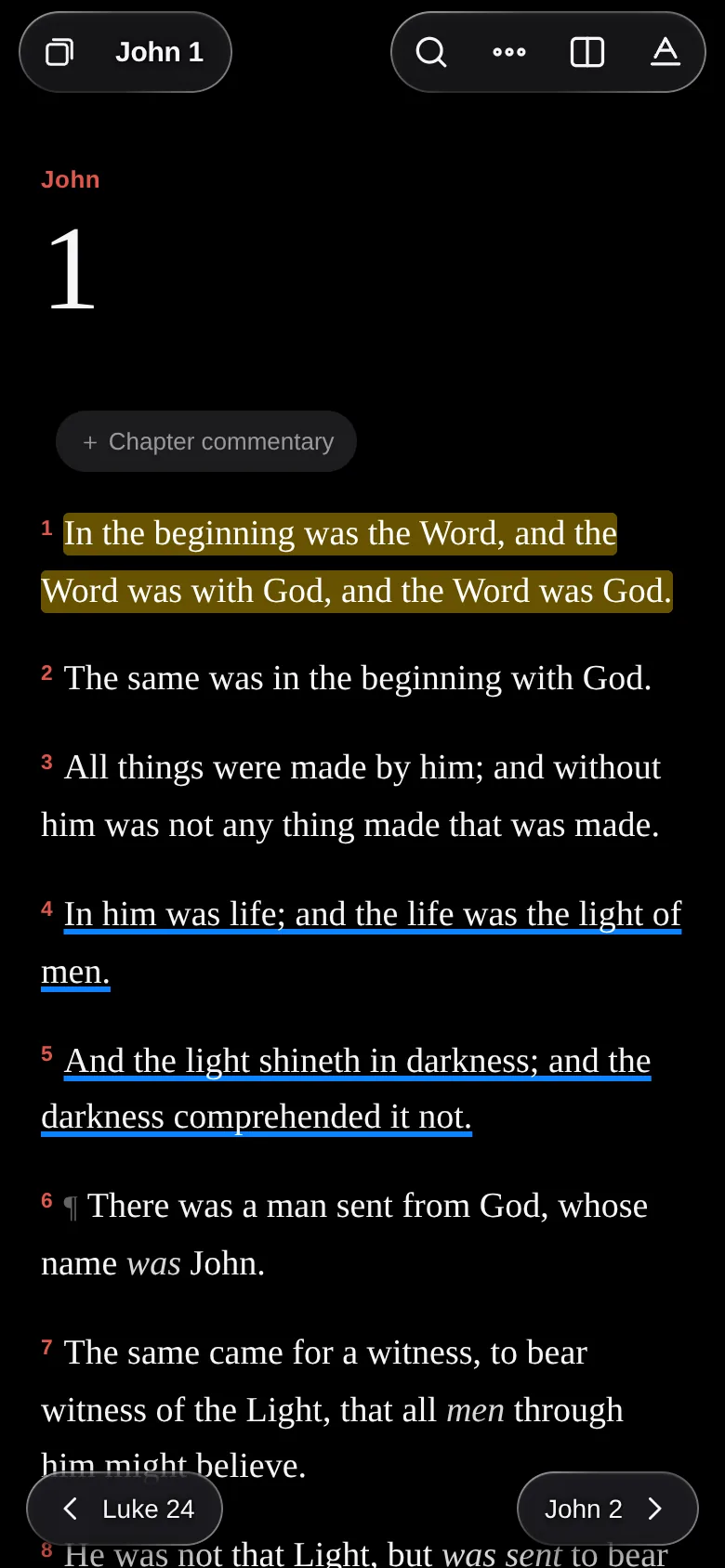
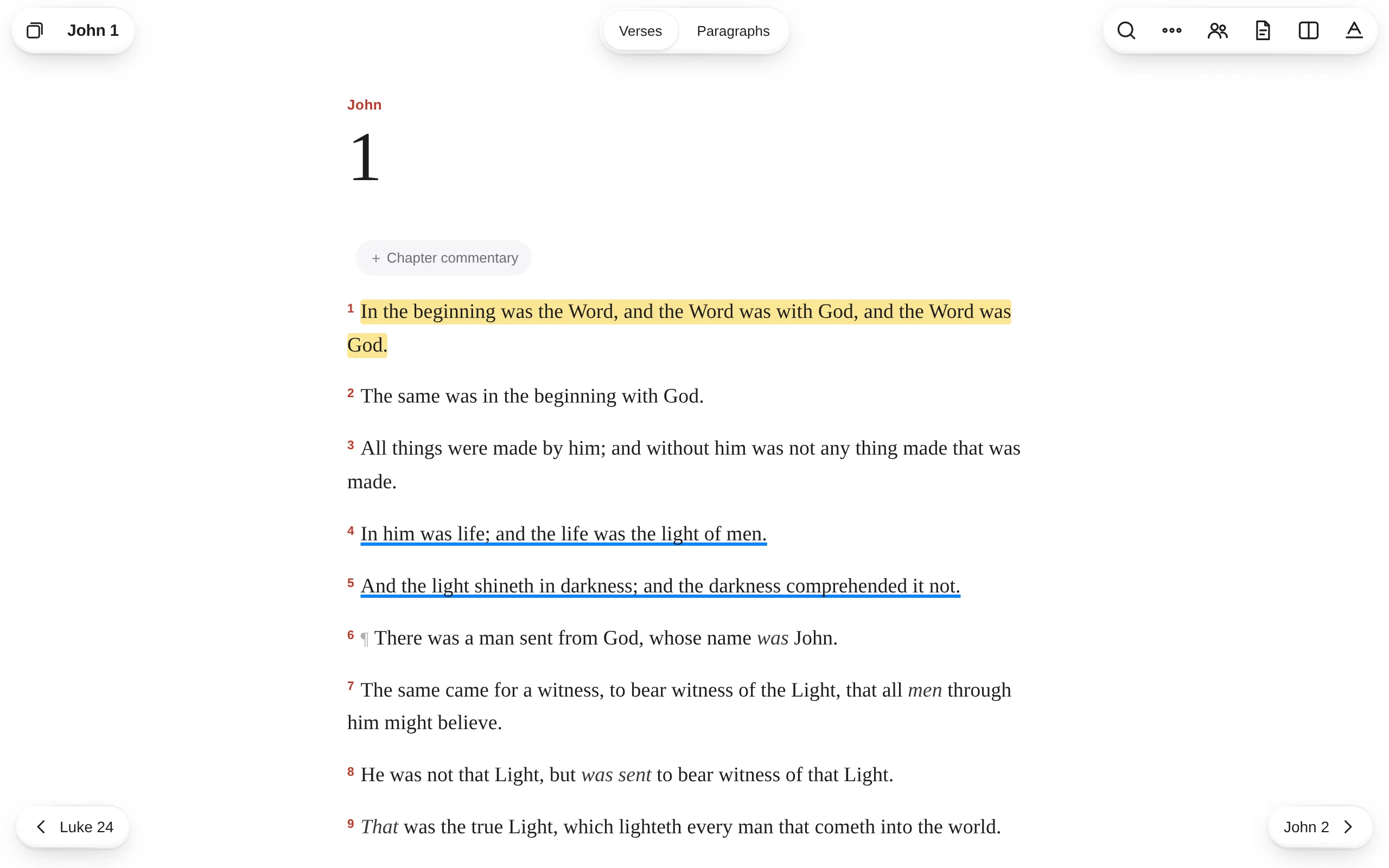
StudyBook open at John 1 in the King James Version: verse 1 highlighted in yellow, verses 4 and 5 underlined in blue, with the chapter buttons and the glass menu pills floating over the page.

What’s in the library

583 books on 37 shelves: 22,796 chapters and 46.9 million words.

Counted from the library itself in October 2026. Every text is in the public domain.

The standard works

41,995 verses

The King James Bible, the Book of Mormon, the Doctrine and Covenants and the Pearl of Great Price: 87 books in 1,582 chapters. Read them in verses or in paragraphs; the Book of Mormon also in its 1830 chapters.

Old Testament
23,145
New Testament
7,957
Book of Mormon
6,604
Doctrine and Covenants
3,654
Pearl of Great Price
635

Bible tools

31,098 verses

The Hebrew or Greek under the English words it stands behind, verse by verse. Beside it, the Berean Standard Bible in parallel, a Hebrew and Greek lexicon of 22,717 entries, Easton’s and Smith’s Bible dictionaries (8,521 entries), Nave’s Topical Bible (5,319 topics) and Webster’s 1828 dictionary (82,683 words).

Beside the Bible

122 books

The Apocrypha of 1611, Enoch and the Testaments of the Twelve Patriarchs, Josephus, Edersheim and the Legends of the Jews, Adam Clarke’s commentary on every book of the Bible, and the Qur’an.

General conference

2,840 talks in full

The 68 Conference Reports of April 1880 and October 1897 to October 1930, with their printed page numbers.

4,049 talks listed

Every talk since April 1971 — 111 conferences — by speaker and session, each linked to the Church’s own site, where the words are.

Journal of Discourses

1,426 sermons

All 26 volumes, 1854 to 1886, every sermon, each with its speaker, date and place, and the page numbers of the bound set.

Church periodicals

295 articles

The Improvement Era from its first number: 15 issues, November 1897 to January 1899, page for page.

Early Latter-day Saint books and journals

49 books

28 of doctrine and sermons, from the Lectures on Faith to Talmage; 8 lives, among them Lucy Mack Smith’s; and 13 journals — Woodruff, Kimball, Clayton — with 18,932 dated entries.

Christian classics and church fathers

76 books

The Ante-Nicene Fathers from Clement to Irenaeus (38), the creeds and the councils (20), and Augustine, Aquinas, Calvin, Thomas à Kempis and Bunyan (18).

Founding documents and political writings

30 books

The Declaration, the Constitution and its amendments, The Federalist and Madison’s notes of the Convention; Locke, Hobbes, Paine, Burke, Tocqueville, Mill and Lincoln.

Philosophy, history and literature

123 books

Plato and Aristotle to Kant and William James; Herodotus to Gibbon; Homer, Dante and Milton to Dickens, Austen, Melville and Twain.

And around the texts

The timeline

2,679 dated entries

1,499 events from Adam to the present — the Bible, the Book of Mormon, the Restoration, the world around them — with the births, deaths and marriages of 552 people in the library.

The map

1,203 places

1,165 places of the Bible and 38 of the Restoration. The 306 whose site is disputed or rests on later tradition alone are marked, and shown only when you ask.

The authors

1,190 people

Speakers and writers with their dates and the 2,067 offices they held, so a sermon shows its speaker’s age that day and the office held.

What it does

Reading

  • 1 Nephi, Chapter I of the 1830 edition, read in its original paragraphs, beginning “I, Nephi, having been born of goodly parents”.

    Verses or paragraphs

    Read in numbered verses, or in paragraphs as first printed: the King James translators’ ¶ marks, the Book of Mormon’s 1830 chapters.

  • Genesis 1 with the word “firmament” tapped: Webster’s 1828 definition, the verses where the word appears, and buttons for Easton’s, Smith’s and Nave’s.

    Tap a word

    Tap any word for Webster’s 1828 dictionary, English as Joseph Smith’s generation spoke it, with Easton’s and Smith’s Bible dictionaries and Nave’s topics a tap away.

  • John 1 with the interlinear on: each English phrase has the Greek word beneath it and its transliteration beneath that.

    The interlinear

    The English stays the line you read; the Hebrew or Greek sits under the words it translates, with its sound. Tap it for the lexicon.

Marking and connecting

  • Alma 32: verse 27 underlined in blue and verse 28 highlighted in green, with a small note marker at its end.

    Highlights and notes

    Highlight or underline in eleven colours and say what each colour means to you. Notes take pictures, places and links, and with an account they follow you to every device.

  • John 3:16 selected, and a panel “Cited in the library (24)” listing where Thomas Aquinas quotes the verse in the Summa.

    Cited in the library

    Choose a verse to see where the sermons, talks and Fathers quote it. Save a quote, and StudyBook shows where the same words appear earlier.

  • The timeline at 1823: Moroni’s visit to Joseph Smith on September 21, D&C 2, and the first visit to the Hill Cumorah.

    The timeline and the map

    Dated events, sermons and lives in one long line, in the Nephite, Hebrew or Islamic reckoning too; the places of a chapter on a map.

Teaching, together, anywhere

  • The lesson planner under Alma 32: a lesson titled “Faith like a seed” with a paragraph and the quoted words of Alma 32:27.

    The lesson planner

    Drag passages from the text into a lesson. They stay quoted exactly, with a link back; write around them, then show it as a document or as slides.

  • A study group’s chat beside Alma 32: a member has shared Alma 32:28, and a reply asks about “a particle of faith”. The people and messages are an example.

    Study groups

    Invite friends or a class. Share passages into the group’s chat, plan studies together, and see the highlights people choose to share.

  • Settings, Offline: 100% downloaded, 397 MB, split into scriptures, library, study tools and the app, with your own notes always on the device.

    Offline

    Books are kept as you open them, or download the whole library (397 MB) and read with no connection at all. Install it from the browser like an app.

Where the words come from

Every text in StudyBook is a public-domain edition, and each book’s About page says which: the King James text of Blayney’s 1769 Oxford edition, with the 1611 printers’ paragraph marks; the Book of Mormon in its 1830 chapters or in Orson Pratt’s of 1879; the Journal of Discourses from proofread transcriptions checked word by word against the scans of the bound set; the Conference Reports from the Church History Library’s scans.

  • Nothing is changed in silence.Where a misprint is put right, a reading is chosen between two scans, or a dropped word is restored, the text carries a note that says what was done and why.
  • The pages are the printed pages.The Journal of Discourses, the Conference Reports and the Improvement Era carry their printed page numbers, 19,247 of them, so a reference found here can be checked on the shelf.
  • Nothing is added from later editions.Modern chapter headings, footnotes and introductions are under copyright and are left out. Where the earliest Greek manuscripts differ from the King James text, a small mark says so.
Saving a quote from Brigham Young in the Journal of Discourses: a card headed “These words appear earlier” shows the same words in 2 Nephi 9:13, 1830, with Open and Save from the original instead.
Brigham Young, 1862, quoting the Book of Mormon. Save the words and StudyBook finds where they first appeared.